Best VPN for Multiple Devices: Simultaneous-Connection Limits Compared (2026)
The best VPN for multiple devices is Surfshark if you want the lowest long-run cost for a big household, because it allows unlimited simultaneous connections and renews at $79 a year for its Starter plan (US, before tax, read 9 October 2026). If ten devices are enough and you want the stronger audit record, NordVPN or Proton VPN Plus cover ten each. Past ten, the cheapest trick is not a bigger plan but a router, which most providers count as a single device.
Device limits are one of the most misreported numbers in VPN reviews: you will still find NordVPN listed at six and ExpressVPN at five or eight. We took every limit below from the provider's own plan or support page on 9 October 2026, and the cost-per-device figures are our arithmetic from those prices, shown so you can check them.
The limits, read from each provider's own page (dated)
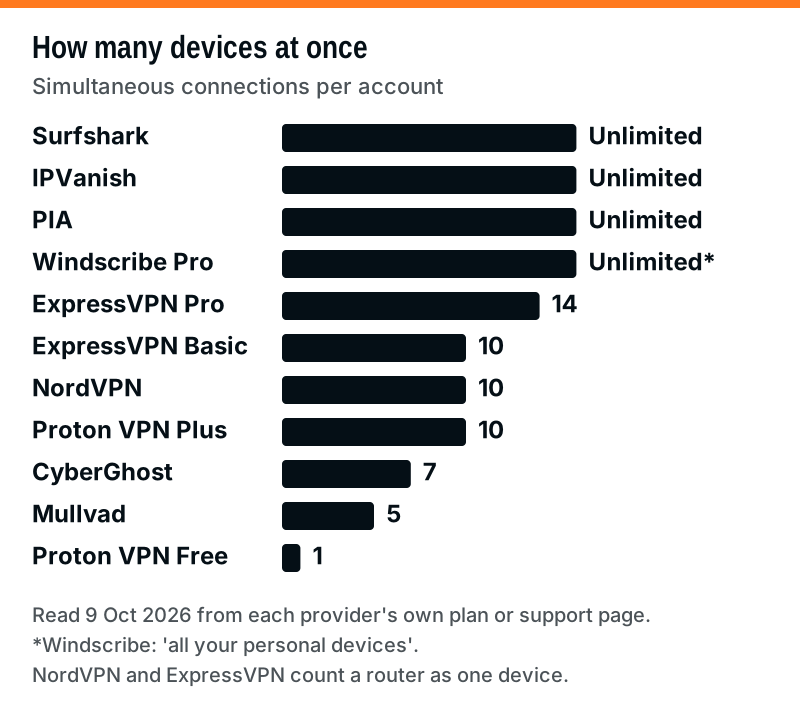
Here is the short version, then the detail. Four services set no numeric cap, four sit at seven to fourteen devices, Mullvad allows five, and one free tier allows exactly one.
| VPN | Devices at once | Router counts as | Renews at |
|---|---|---|---|
| Surfshark (all plans) | Unlimited (trial: 3) | Not needed | $79-$119/yr |
| IPVanish (all plans) | Unlimited | Not needed | $99.99-$129.99/yr |
| PIA | Unlimited | Not needed | Price not verified |
| Windscribe Pro | All personal devices | Not needed | $69/yr |
| ExpressVPN | 10 / 12 / 14 by plan | 1 device | $99.95-$199.95/yr |
| NordVPN | 10 (5 per server) | 1 device | $139.08/yr (Basic) |
| Proton VPN Plus | 10 (Free: 1) | Not stated | $83.88/yr |
| CyberGhost | 7 | Not stated | $56.94/yr |
| Mullvad | 5 | Not stated | EUR 5/mo flat |
A few notes on where those numbers come from. NordVPN's support article says ten devices on one account, with a catch most reviews miss: no more than five of them can sit on the same server at once, because each needs a different protocol there. ExpressVPN ties its limit to the plan: 10 on Basic, 12 on Advanced and 14 on Pro. Surfshark's limit is unlimited on paid plans but only three during its free trial. Windscribe does not state a number; its knowledge base says you can use it on "all your personal devices", which is a personal-use rule rather than a technical cap. PIA's unlimited limit is verified, but we could not read a US price for it on 9 October 2026, so we give none.
What counts as a device (and how a router changes the count)
Limits count connections at the same moment, not installs. You can install NordVPN or Proton on twenty gadgets and stay within the rules, as long as no more than ten are connected at once. A phone that is switched off, or a laptop with the VPN app disconnected, does not use a slot. That alone solves the problem for many households: the family tablet and the work laptop are rarely online through the VPN at the same time.
A router changes the maths completely. When the VPN runs on your router, every device behind it, including smart TVs, consoles and doorbells that cannot run a VPN app, shares one tunnel. In the words of NordVPN's support article, a router "uses only one device slot, but the VPN will protect all the devices connected to the network," and ExpressVPN's device-limit support article (updated 12 August 2026) counts a router as one connection in its own examples and says you can connect as many devices to it as you wish. So a five-device Mullvad plan, or a seven-device CyberGhost plan, can cover an entire house: one slot for the router, the rest for phones that leave home.
The trade-offs are real. Router VPNs need a compatible router or firmware, every device at home gets the same server location, and the router's processor often caps throughput below what your line can do. Apps on individual devices also give you per-device kill switches that a router setup does not. Most households end up with a hybrid: the router for the living room, apps on phones and laptops.
Cost per device for real households
The fair way to compare is the yearly renewal price, the one you pay from year two or three onward, divided by the devices you actually need to cover. Where a plan's cap is lower than your device count, we price in a second or third account rather than assume a router. All figures are US prices before tax, as listed on 9 October 2026.
| Plan | Per year | 4 devices | 8 devices | 12 devices |
|---|---|---|---|---|
| Surfshark Starter | $79.00 | $19.75 | $9.88 | $6.58 |
| Windscribe Pro | $69.00 | $17.25 | $8.63 | $5.75 |
| IPVanish Essential | $99.99 | $25.00 | $12.50 | $8.33 |
| CyberGhost | $56.94 | $14.24 | $14.24 (2 accts) | $9.49 (2 accts) |
| Proton VPN Plus | $83.88 | $20.97 | $10.49 | $13.98 (2 accts) |
| ExpressVPN Basic | $99.95 | $24.99 | $12.49 | $10.00 (Advanced) |
| Mullvad | $67.20 (EUR 60) | $16.80 | $16.80 (2 accts) | $16.80 (3 accts) |
| NordVPN Basic | $139.08 | $34.77 | $17.39 | $23.18 (2 accts) |
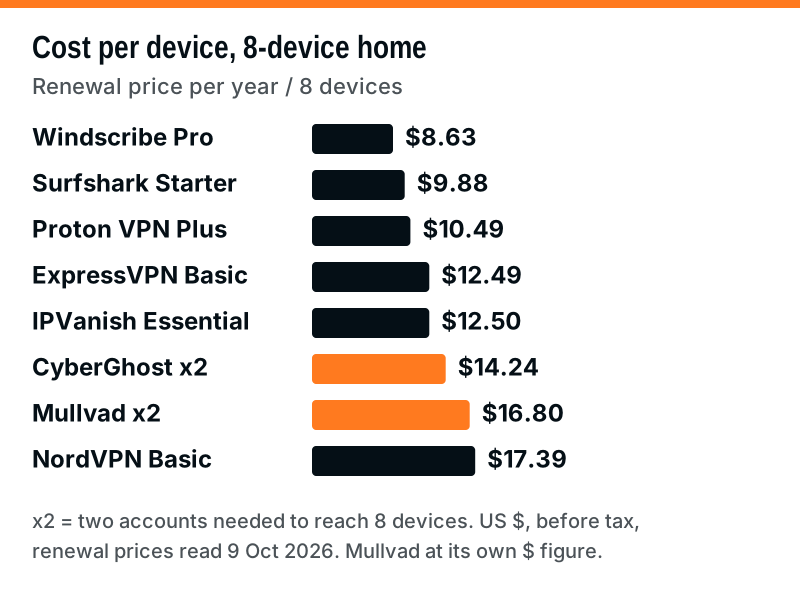
Three things jump out. First, unlimited plans get cheaper with every device you add: Surfshark Starter falls from $19.75 a device at four devices to $6.58 at twelve, and Windscribe Pro to $5.75. Second, a capped plan is fine until you cross its cap, then the cost per device jumps; CyberGhost is the cheapest option at four devices but needs a second account at eight unless you use a router. Third, NordVPN's renewal price makes it the most expensive per device here at four and eight devices, which is the cost of its feature set rather than a reason to avoid it.
First-term prices are much lower than these figures across the board. Surfshark Starter, for example, is billed $67.23 for its first 27 months, and Proton VPN Plus $83.76 for its first 24. Use the renewal maths to judge the long run and the intro price to judge the first bill.
The first-term view
The renewal maths shows the long run; the first bill tells a different story, because long plans are discounted hard. Spreading each first-term bill over its length and dividing by eight devices gives the table below. NordVPN is left out because we could not re-read its intro price directly on 9 October 2026.
| Plan | First bill | Per year | Per device, 8 devices |
|---|---|---|---|
| IPVanish Essential | $57.36 / 24 mo | $28.68 | $3.59 |
| Surfshark Starter | $67.23 / 27 mo | $29.88 | $3.74 |
| ExpressVPN Basic | $83.72 / 28 mo | $35.88 | $4.49 |
| Proton VPN Plus | $83.76 / 24 mo | $41.88 | $5.24 |
| CyberGhost | $56.94 / 26 mo | $26.28 | $6.57 (2 accts) |
| Windscribe Pro | $69.00 / 12 mo | $69.00 | $8.63 |
| Mullvad | $67.20 / 12 mo | $67.20 | $16.80 (2 accts) |
On this view the long-plan intros from IPVanish and Surfshark cost under $4 a device a year, while Mullvad's flat price looks expensive. Run both views before you commit: the renewal table is what you pay once the first term ends, this one is what you pay up front. A plan that wins only in the first term is a plan to re-evaluate at renewal, not one to forget about.
Setting one plan up across a household
A shared plan works best with a little planning on day one.
- Count peak devices, not owned devices. Note which phones, laptops and TVs genuinely need the VPN at the same time in your busiest hour. That number, not the total, decides the plan.
- Put fixed devices behind the router if you can. TVs, consoles and smart speakers rarely move, so a router VPN covers them in one slot and leaves app slots for phones and laptops that leave home.
- Install from official sources only, and sign each device in with the same account.
- Switch on the kill switch on every device, not just the first one you set up. It is a per-device setting in every app whose documentation we read.
- Decide who owns the account. One person controls billing, auto-renewal and the password. If that is not workable, buy two smaller plans.
Unlimited plans: the fine print
"Unlimited devices" is a real feature, but read it carefully. Surfshark's unlimited cap applies to paid plans; its free trial allows three devices. Windscribe frames its policy around personal use, so it is not a licence to share one account across several unrelated households. IPVanish shows unlimited devices on every plan card, including monthly. Unlimited also says nothing about speed: every device still shares the bandwidth of the server it connects to, and of your own internet line.
There is a privacy angle too. Sharing one account across a household means everyone's sessions sit under one login and one email address. If two adults want separate accounts, two smaller plans can be the cleaner choice even when one unlimited plan is cheaper.
Picks by household size
Choose by how many devices are online at the same moment, not by how many you own.
- One to four devices: CyberGhost at $56.94 a year on renewal is the cheapest per device, with 45 days to claim a refund on its 2-year plan. Proton VPN Plus at $83.88 a year buys open-source apps and five consecutive Securitum no-logs audits.
- Five to ten devices: NordVPN or Proton VPN Plus, both at ten devices. NordVPN brings the deeper feature set; Proton the lower renewal.
- More than ten, or a family that shares: Surfshark or IPVanish, both unlimited. Surfshark renews lower; IPVanish's cheapest plan renews at $99.99 a year.
- Privacy first, few devices: Mullvad, at a flat €5 a month for five devices, no email needed, plus a router slot for the home network. It pays us nothing.
If unlimited devices at the lowest renewal is the brief, see Surfshark's current plans. If ten devices and the longer audit record suit you better, check NordVPN's price. Both are affiliate links; they never change our scores, which sit on our best VPN ranking.
Edge cases worth checking before you buy
Shared servers on NordVPN. Five of your devices can share one NordVPN server, so a family all on the "recommended" server at once may see the sixth device pushed elsewhere. Pick different locations if that happens.
Smart TVs and consoles. Many cannot run VPN apps at all. Apple TV can, on tvOS 17 or later, and NordVPN, Surfshark, ExpressVPN and Proton (paid plans) all have tvOS apps. NordVPN does not support Roku, which is a router job.
Monthly plans. Billing term does not change the device limit for NordVPN or IPVanish, per their pages, but monthly prices are much higher: NordVPN does not let you pay monthly except on its 1-month plan, and IPVanish's monthly Essential plan is $14.99.
Free tiers. Proton's free plan covers one device. Windscribe's free plan has no device cap but a shared monthly allowance of 10GB after email confirmation, which a household will burn through quickly.
Multiple-device VPN questions
Which VPN allows the most devices?
How many devices can I use with NordVPN?
Can I share one VPN account with my family?
Does a VPN router count as one device?
What is the best VPN for a family?
See where this lands against the field: the best VPN 2026, ranked by Gauge Score, or the best VPN for privacy.